Choose one bet and test it
Turn research into evidence. Stop keeping every possible project open.
How to actually win when everyone has artificial intelligence.
Turn endless answers into real action.
Build better judgment. Keep ownership of your work.
First two chapters + a three-day challenge. No signup required.
Explore the introduction and first two chapters, just as they appear in the book.
Turn the pagesBring a task you already need to finish. Work through the practical worksheet.
Open the worksheetBrowse the nine chapters and see what feels relevant to you.
Explore the contentsYou have the models, the saved prompts, and another tool to try. But more answers haven’t always meant better decisions—or work you actually finish.
This book helps you move from asking what AI can do to deciding what you will do with it.

Turn research into evidence. Stop keeping every possible project open.
Build the taste to spot polished mediocrity and verify what matters.
Turn recurring problems into systems while keeping responsibility for the result.
What is one experiment you will actually run?
Try this with a task of your ownBefore you see what AI says, make your own call.
You have an idea for a service that turns long videos into short clips. A few friends say it sounds useful. No potential customer has seen it yet.
You have four hours this weekend. Where do you start?
A plan is still a guess.
Your move:
Illustrative AI answer · written for this exercise
“This is a promising opportunity. Start with three service packages, a polished landing page, and a 30-day content calendar to attract your first clients.”
What evidence would change your mind?
A confident answer can help you move. You still decide whether it points in the right direction.
Write down your next move and why. Then ask AI to challenge it. What would you need to learn before spending the whole weekend on the idea?
Try it in the worksheetStart with better tactics. Build stronger strategy. Keep the judgment, responsibility, and purpose that make the work yours.
From choosing a project and evaluating answers to systems, skill, and human agency.
Test a business idea. Research a decision. Use capable tools without handing over the part that matters.
The AI Operator Challenge and Operator Kit help turn the ideas into operating habits.
Learn to test answers against evidence and turn research into contact with reality. Read the essay
Choose one bet. Give it a real window to work before chasing the next possibility. Read the essay
Delegate execution while retaining judgment and responsibility. Read the essay
Build the taste to distinguish good work from polished mediocrity. Read the essay
Know when you need a result and when you need the practice that builds your ability. Read the essay
Turn recurring work into reusable examples, templates, rules, and systems. Read the essay
Separate work, coordinate capabilities, and keep ownership of the final result. Read the essay
Strengthen your ability to direct, judge, verify, and act. Read the essay
Consider the purpose of recovered time and the authority you will not hand to a machine. Read the essay
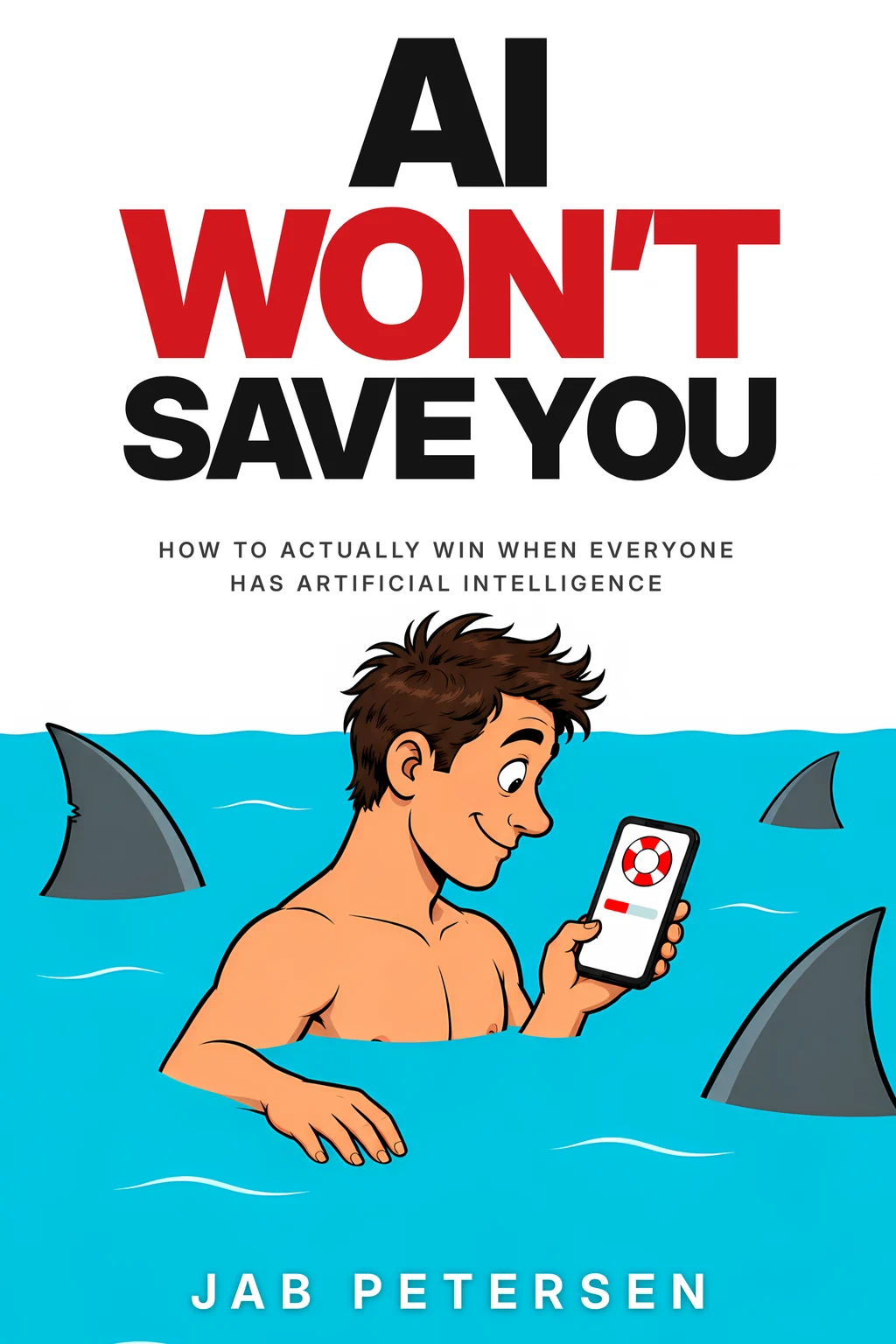
Jab Petersen
AI Won’t Save You
Read at your own pace or try an idea on work you already have. The free resources are yours without a signup.
The opening argument and the cost of keeping every door open. Includes the introduction and author’s note.
Read the sample PDFChoose a small task, check what matters, and put the result to use. Adapted from the book.
Get the challenge PDFA place to think before prompting, record your evidence, and decide what you’ll do next.
Open the worksheetWant to read the whole book and share what helped? Request a free digital review copy. No purchase or positive review required.
People using AI for creative work, independent projects, research, or everyday decisions who want to turn its capabilities into useful results. It is especially relevant if you spend more time generating possibilities than acting on them.
No. The field manual is deliberately tool-agnostic. The focus is on how you direct, test, and use capable systems as interfaces change.
The book goes beyond prompts: nine chapters develop the argument, followed by twelve workflows, a 30-day challenge, and an Operator Kit with practical exercises.
Yes. Alongside practical AI use, the book explores responsibility, character, and purpose from a Christian perspective. The author’s faith is part of the argument about what technology is for.
The ebook is available on Payhip and Google Play Books; the links are in the book section. Review the current price and purchase details there. The paperback, with the Kindle edition, is available on Amazon.
A practical path from AI capability to human agency.
Read a free excerpt