The twelve one-page tools from the back of the book, ready to print or save as PDF. Each one fits on a card next to your keyboard.
1
The 10-10-1 Reality Move
Use when: you have been researching, prompting, or planning without touching reality.
The question I am actually trying to answer:
The three most important assumptions:
Ask AI: Which assumption is most fragile? Design three real-world tests I can run quickly. Prefer behavior over opinions. Then complete one external action.
Rule: Do not ask for another strategic answer until you have produced new evidence.
2
The One-Bet Page
For the next days, my one bet is:
Why this bet deserves the window:
What would make me stop or change it:
NOT NOW:
Give your AI this instruction: Optimize inside my current bet. When I start exploring unrelated options, remind me of my NOT NOW list. Do not recommend changing the bet unless new evidence directly attacks the assumptions above.
3
Before the Prompt
My current answer is:
Because:
Then ask AI: Attack this reasoning. Identify hidden assumptions. Give me the strongest opposing case. Tell me what evidence would change the conclusion. Do not decide for me.
My decision:
Evidence I still need:
4
The Taste Library
Choose one domain. Collect twenty excellent examples and five weak examples. For each, answer:
- What is it trying to accomplish?
- What specifically works or fails?
- What did the creator remove?
- What would a generic version do?
- What standard is present?
Then use AI to find patterns in your judgments. Correct the AI where necessary.
Goal: Turn “I like it” into standards you can use.
5
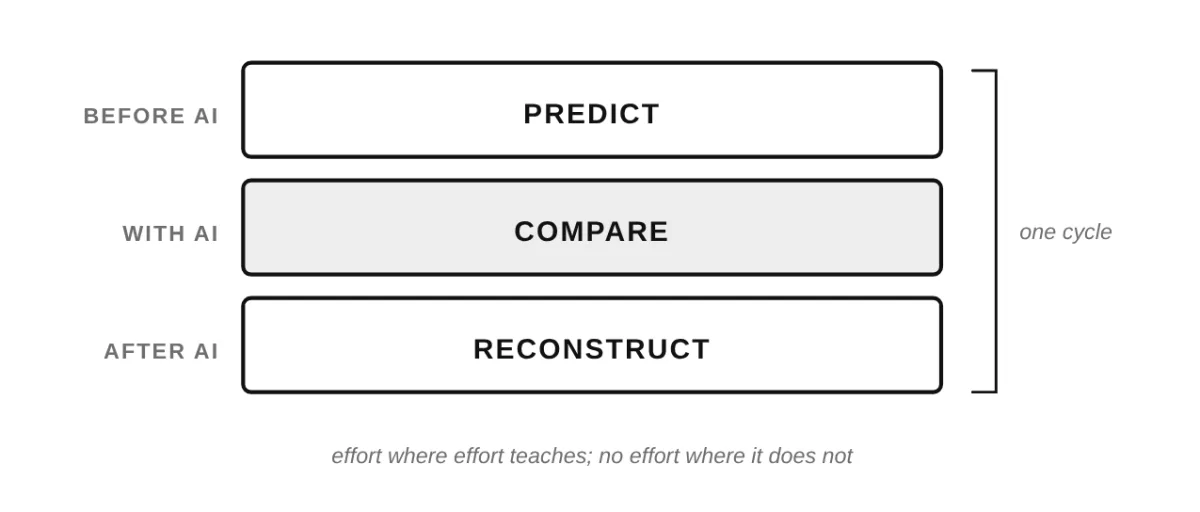
Performance or practice
Before offloading a task, mark it:
PERFORMANCE: I primarily need the result.
PRACTICE: I need the task to build me.
For practice mode: ATTEMPT → AMPLIFY → EXPLAIN → APPLY → OFFLOAD
AI instruction: Do not give me the full answer. Coach me. Ask questions, provide hints, critique attempts, and test transfer.
6
The Residue Audit
Choose a repeated task.
Trigger: What starts it?
Context: What information is always needed?
Standard: What does good look like?
Action: What can be standardized?
Escalation: What must remain human?
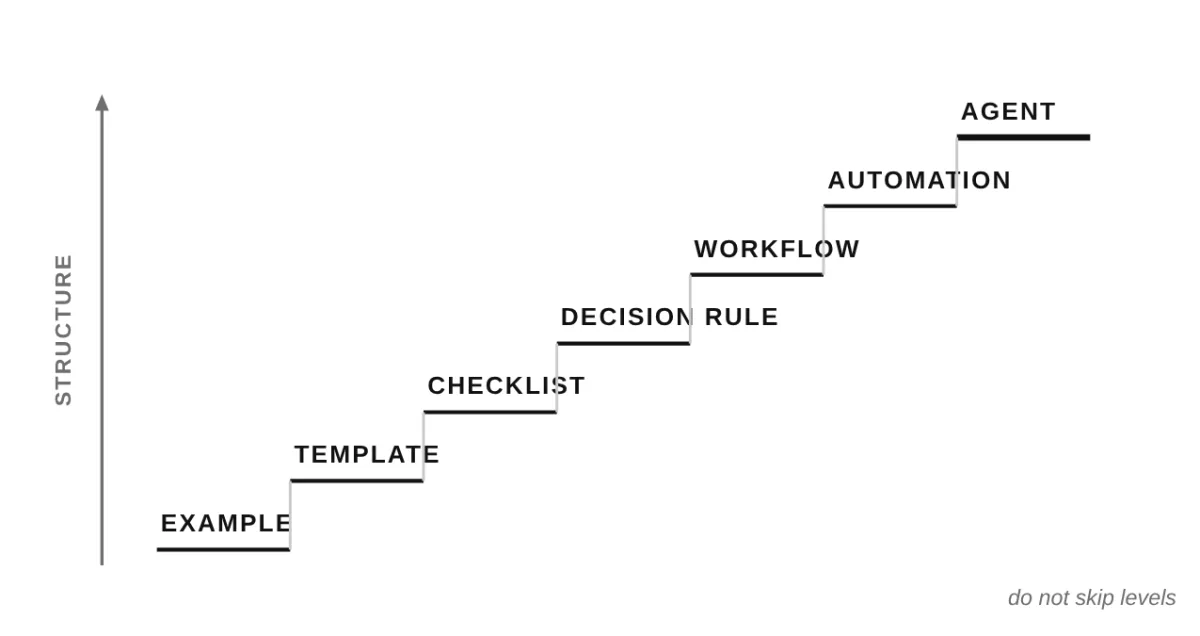
Then move only as far as needed: Example → Template → Checklist → Decision Rule → Workflow → Automation → Agent
7
The Orchestration Map
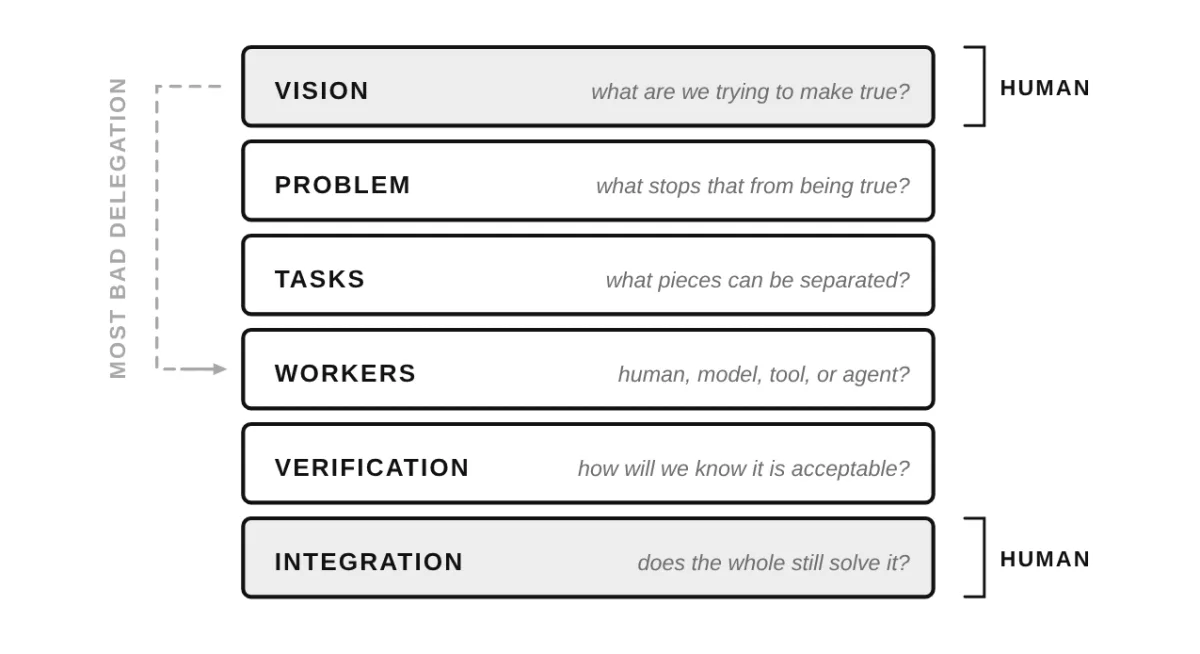
Vision: What are we trying to make true?
Problem: What is stopping it?
Tasks: What can be separated?
Workers: Human / AI / software / agent?
Verification: How will each output be checked?
Integration: Who owns the final result?
8
The escalation line
For any automated action, score:
Consequence: low / medium / high
Reversibility: easy / difficult / impossible
Uncertainty: low / medium / high
Missing context risk: low / medium / high
As consequence, irreversibility, uncertainty, or missing context rise, move the decision upward toward human judgment.
9
Four questions for the operator
Before increasing leverage, answer:
Can I direct? Can I clearly specify the desired outcome and constraints?
Can I judge? Can I distinguish good from polished?
Can I verify? Do I know what evidence or tests matter?
Can I act? Can I stop generating and commit?
10
Audit what AI amplifies
Review your last twenty substantial AI sessions. For each, label what it amplified:
curiosity · learning · execution · avoidance · indecision · perfectionism · courage · self-justification · discipline · dependency · something else
Then answer: If AI became ten times more capable tomorrow, what in me would become dangerous?
11
The Agency Test
After using AI, ask:
Am I more capable of acting, or merely more capable of asking?
12
The Authority Line
AI may execute:
AI may advise, but I retain responsibility:
I will not outsource ultimate authority over:
The point is not to draw everybody’s line in the same place. The point is to know that a line exists.